
In 2022 a British journalist got a Netflix series, and archaeologists spent the next two years being asked about it at parties.
The show was Ancient Apocalypse. Graham Hancock's argument was that an advanced civilisation existed during the last Ice Age, was destroyed by a cataclysm around twelve thousand years ago, and that its survivors fanned out across the world teaching primitive hunter-gatherers how to farm, how to build, how to read the sky.
I agree that it is nonsense. I also think the people dismissing it mostly failed to answer the question that made it persuasive.
Because Hancock was pointing at something real.
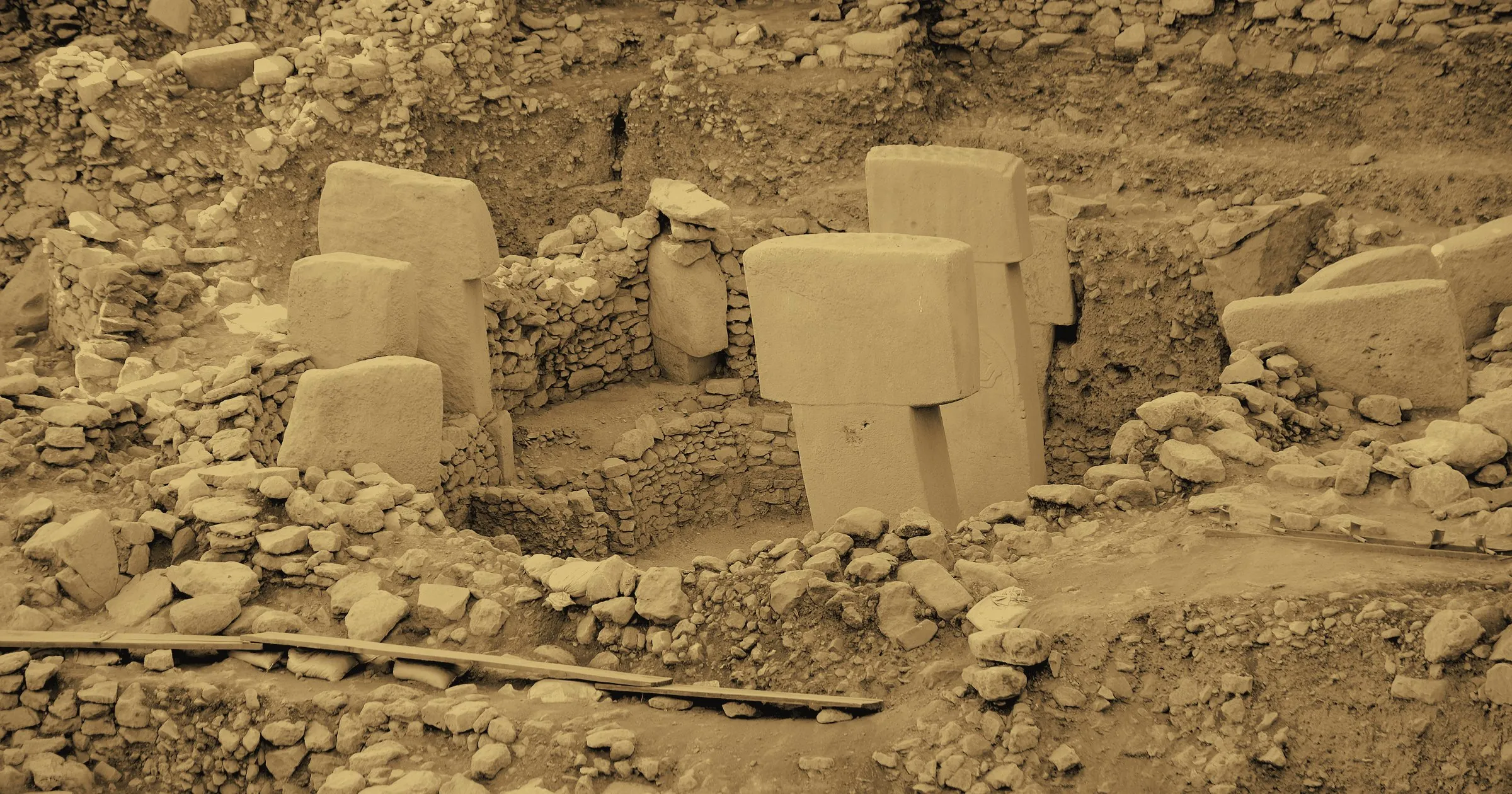
Göbekli Tepe sits in southeastern Turkey and dates to roughly 9600 BCE. Massive carved stone pillars, arranged in sophisticated circular enclosures, raised six thousand years before Stonehenge. Six thousand. The gap between Göbekli Tepe and Stonehenge is larger than the gap between Stonehenge and you.
In 2024 researchers argued that the carvings on Pillar 43 at Göbekli Tepe encode a lunisolar calendar: 365 days, twelve lunar months, eleven epagomenal days to make the arithmetic work.
The oldest complex calendar in human history, cut into stone by people who supposedly had not yet worked out farming.
So the question is fair. Where did that come from?
Hancock's answer is Atlantis. One advanced civilisation, now lost, which seeded the rest.
I want to suggest that this answer is not only unnecessary. It is, in a way its defenders never seem to notice, an insult.
Look at the shape of the argument. Peoples across four continents build astronomical alignments, develop agriculture, raise monuments, work out mathematics. Rather than conclude that these peoples were capable of it, the theory requires a vanished civilisation, conveniently undiscoverable, to have handed it to them. The achievement is removed from the people who left the evidence and given to a civilisation that left none.
There is a better answer, and it has been sitting in plain sight.
Knowledge arose everywhere because the capacity for it is built into us.
The Islamic tradition has a word for this: fitrah, the innate disposition toward truth that every human being is born carrying.
If the capacity is universal, then distant and unconnected peoples developing astronomy, mathematics, agriculture and monumental architecture is not an anomaly demanding a special explanation. It is the base case.
The hunter-gatherers of the Taş Tepeler built Göbekli Tepe. Not refugees from a drowned empire. Them.
Which changes the question you ask of any idea you hold.
Not: who invented this?
But: who carried it, and from whom?