
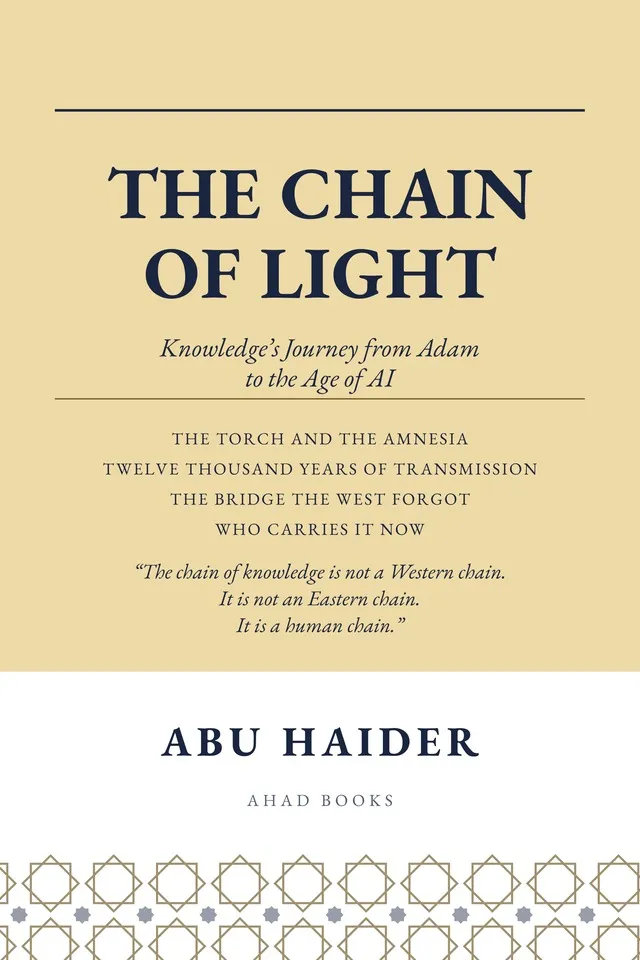
The Chain of Light
How Knowledge Travelled, from Adam to the Age of AI
Six thousand years before Stonehenge, hunter-gatherers in southeastern Turkey raised carved stone pillars in planned enclosures and cut a lunisolar calendar into one of them. They were not supposed to be capable of it. The popular explanation is a lost continent. The academic one is an embarrassed silence. There is a third, and it leaves the achievement with the people who left the evidence.
29 essays, one for each chapter, all free to read.
Start reading
Coming soon
- IntroductionGöbekli Tepe Does Not Need AtlantisA Netflix series asked a fair question about a site six thousand years older than Stonehenge, then answered it with a lost continent. There is a better answer, and it leaves the achievement with the people who left the evidence.
- Chapter 1: The First TeacherYou Do Not Own What You KnowEvery hadith carries a chain of names running back to the man who heard the words spoken. Set that beside how we hold knowledge now, as property rather than a trust, and the contrast starts to bite.
- Chapter 2: The Antediluvian WorldCivilisation Did Not Begin With a HarvestFarming, then surplus, then hierarchy, then cities, then civilisation. The oldest domesticated wheat grows thirty kilometres from a temple that predates it, which suggests the arrow points the other way.
- Chapter 3: The Flood and the FractureEverybody Remembers the WaterSea level stood 120 metres lower and rose in pulses fast enough to move a coastline within a lifetime. The flood myths are not evidence of a lost continent. They are a storage medium that worked.
- Chapter 4: The Forgotten BuildersA Paradigm Is a Career RiskChildren's footprints at White Sands, twenty-three thousand years old, in a place the ice-free corridor could not have delivered anyone to. The date is not the interesting part. The thirty years it took to accept it is.
- Chapter 5: Sumer and MesopotamiaObjects Do Not ForgetA bored accountant in Uruk presses a reed into clay and becomes the point at which knowledge stops being as mortal as the people carrying it. Something is gained, and something quieter is lost.
- Chapter 6: EgyptThe Library of Alexandria Did Not Burn DownFour events across seven centuries, only one of them a fire. What actually killed the library is duller and far more frightening, and it has an uncomfortably modern shape.
- Chapter 7: The Indus Valley and Vedic IndiaWe Know Their Drains, Not Their MindsFive million people, a million square kilometres, sanitation Europe would not match for four thousand years, and not one readable word. Our ranking of ancient civilisations is substantially a ranking by preservation.
- Chapter 8: ChinaFour Centuries Before GutenbergBi Sheng set movable type in the 1040s. Gutenberg got the statue. The mechanism behind that is more ordinary than malice, which is exactly why it is probably running right now.
- Chapter 9: AfricaThey Had to Censor the ArchaeologistsGreat Zimbabwe's attribution was settled by the 1930s, and a modern state spent decades suppressing it. The chain was intact and the register was falsified, which is harder to repair than a fire.
- Chapter 10: GreeceThe Greeks Told Us Where They Got ItThales studied in Egypt. Herodotus said geometry was Egyptian. Plato has a priest call the Greeks children. The Greek miracle is a later invention, and the Greeks are on record contradicting it.
- Chapter 11: PersiaNeither Snow Nor RainThe US Postal Service motto is Herodotus describing Persian couriers, carved into granite without credit to either. Bridges get forgotten because their achievement is always recorded in somebody else's column.
- Chapter 12: RomeRome Could Afford to Think and Chose Not ToFour centuries of wealth, peace, literacy and access to every library in the Mediterranean. Put those conditions in Baghdad or Córdoba and you get an explosion. Rome got aqueducts.
- Chapter 13: The AmericasFour Books SurvivedManí, July 1562. The most successful act of intellectual destruction in recorded history, and the reason you cannot name what was lost is that it worked.
- Chapter 14: East AsiaThe Empire That Chose DifferentlyTwo continental empires, the same administrative problems, opposite outcomes. Nobody in either experienced it as a choice. They simply decided, year after year, what to fund.
- Chapter 15: IqraThe First Command Was ReadIt could have been obey, submit, believe or worship. It was read, given to a man who could not, and repeated until he did. A civilisation founded on that word has a permanent reason to care about text.
- Chapter 16: Bayt al-HikmaPaid the Weight of the Book in GoldA Nestorian Christian bargaining with a Muslim caliph over the price of translating pagan Greek philosophy into the language of the Qur'an. Every part of that sentence is doing work.
- Chapter 17: The PolymathsHistory's Most Productive ImprisonmentIbn al-Haytham wrote the scientific method under house arrest, 550 years before Bacon was born. He managed it because he had ten years in which nobody could ask him for anything.
- Chapter 18: Islamic Knowledge NetworksThey Called Them Indian NumeralsAl-Khwarizmi credited India. Fibonacci credited the Arabs. The register was kept carefully for six hundred years and then dropped by the beneficiaries, once the debt stopped being useful to acknowledge.
- Chapter 19: The Transmission to EuropeEurope Got Its Homework Back With CorrectionsGerard of Cremona went to Toledo for one book and stayed thirty years. What came back was not a restoration: the texts had been read, argued with and extended in Arabic for five hundred years.
- Chapter 20: The RenaissancePetrarch Invented the Dark AgesA stylistic complaint about Latin prose hardened into a description of an epoch, and then of the world. It draws the map so that the lit portion falls outside the frame.
- Chapter 21: The EnlightenmentTwo Men Doubted EverythingAl-Ghazali in 1095 and Descartes in 1641 doubted the same three things in the same order and had the same crisis. There is no smoking gun, and it is not the way to bet.
- Chapter 22: ColonialismA Burglar Who Finds a MasterpieceReturning the artefacts should happen and does not settle the account. You can send the manuscripts back; you cannot send back the six centuries of practice that would let someone extend the argument in them.
- Chapter 23: The Industrial RevolutionThe Weavers Were Not Out-InventedDhaka muslin needed a particular cultivar, a particular river, and spinners trained from childhood. Recovering it now takes genetics and a research budget. In 1750 it was routine commercial production.
- Chapter 24: The American CenturyNobody Asks What It Is ForEvery knowledge civilisation in this book had an answer to what knowledge is for, and the answer decided what got funded. Ask it now and you get a proxy: growth, competitiveness, shareholder value.
- Chapter 25: The Death of ThinkingWednesday Afternoons, If There Are No MeetingsWe have solved every material constraint that slowed Baghdad or Toledo, and reintroduced the only one that mattered. Al-Khwarizmi would be asked about pathways to impact.
- Chapter 26: China and IndiaChina Remembers. Does China Think?If the next civilisation runs the Western model at greater scale, on the same knowledge base, under the same time-poverty, the chain has not been rescued. It has changed hands, and the new hands are just as busy.
- Chapter 27: The Muslim QuestionThe Word Is 'Preserved'One lesson in Year 8, an astrolabe, and a word that turns a civilisation into a storage facility. And the harder half: nobody told her at the mosque either.
- Chapter 28: The Chain UnbrokenThe Chain Is Unbroken. It Is Waiting.The conditions are the same five things in every civilisation across twelve thousand years, and they are cheap. The capacity was never damaged. They are simply not being given the time, and that is a policy, not a fate.