
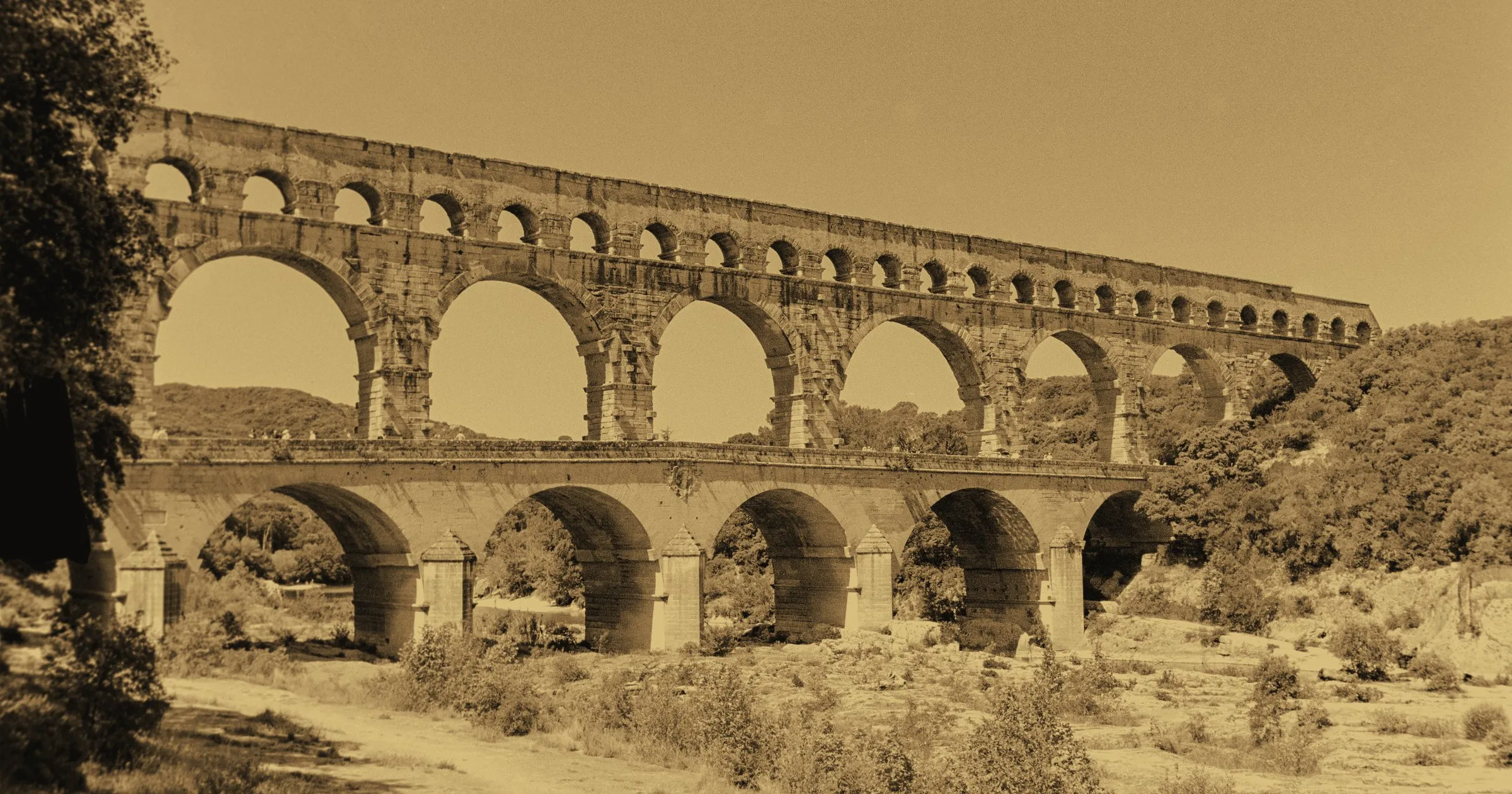
Picture a Roman senator in the second century, at the height of it. The empire runs from Britain to the Euphrates. The roads are the best in the world and will not be bettered in Europe for seventeen hundred years. The aqueducts work. The law is sophisticated enough that we still teach it.
Now look at what he is doing with his afternoon.
He is not reading a new philosophical treatise, because no Roman has written one of significance. He is not working through a mathematical proof; Rome's contribution to mathematics is close to nil. He is not visiting a research institution, because Rome has none.
He is surrounded by inherited knowledge and has produced almost none of it.
Rome is the first civilisation in this book that had everything required to build a knowledge tradition and declined.
That is a stronger claim than it sounds, so let me be careful with it. Rome was not stupid, and it was not incurious in every direction. Roman engineering was genuinely excellent: concrete that has outlasted modern equivalents, water management at a scale nobody matched for a millennium and a half, military logistics that are still studied. Roman law is a real intellectual achievement, abstract, systematic and generative.
But notice the shape of all of it. Every one of those is a practical discipline aimed at control: of water, of terrain, of populations, of disputes. Rome was superb at applying knowledge and almost entirely uninterested in producing it.
The conditions were all present. Wealth beyond anything the Mediterranean had seen. Four centuries of political stability across most of that span. A communications network that could move a message from Londinium to Antioch. A literate administrative class with leisure. Access, through conquest, to the libraries and scholars of Greece, Egypt and the Near East simultaneously.
Put those conditions anywhere else in this book, Baghdad in the ninth century, Córdoba in the tenth, Song China, and you get an explosion. Rome got aqueducts.
So what was missing?
Not capacity. Not resources. What was missing was the conviction that understanding the world is worth doing for its own sake, and the institutions that follow from holding that conviction.
We tend to assume that prosperity and stability produce intellectual flourishing more or less automatically. Get rich, get peaceful, and the thinking follows. Rome is four centuries of evidence that it does not.
What it takes is a decision, held long enough to become institutional, that understanding is worth paying for before anyone can say what it is for.
The Greek texts survived. They survived in Byzantium, and in Syriac, and above all in Arabic.
They did not survive in Rome, which had owned them for four hundred years and never quite got round to reading them.