
On post offices across the United States there is an inscription: Neither snow nor rain nor heat nor gloom of night stays these couriers from the swift completion of their appointed rounds.
It is the unofficial motto of the US Postal Service, and it is not American. It is Herodotus, in the fifth century BCE, describing with open admiration the Persian courier system of the Achaemenid Empire.
The words are carved into the granite of a federal building in Washington without attribution to the Greek who wrote them or the Persians he was writing about.
Which is, in one artefact, the whole subject of this book.
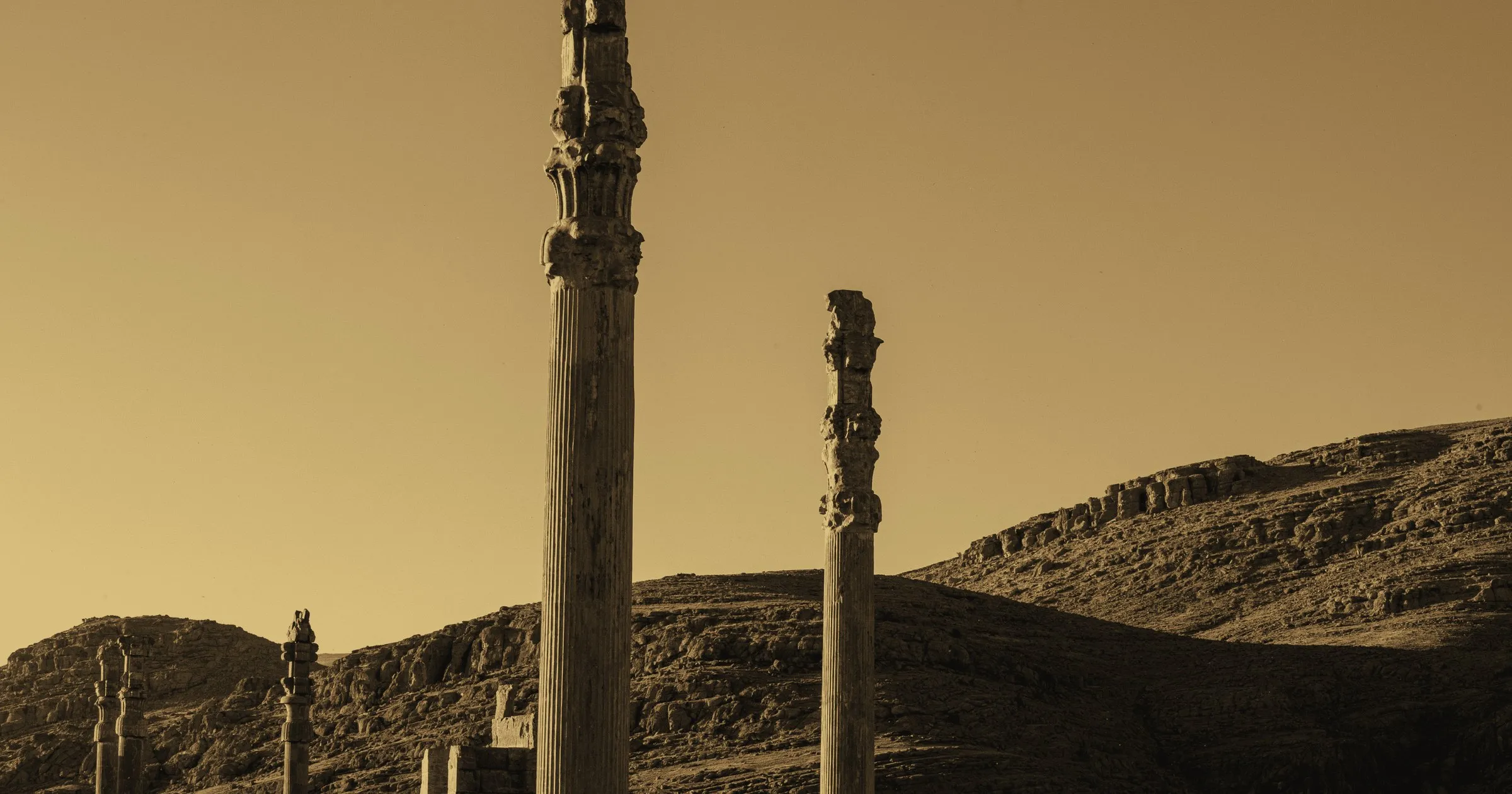
The Achaemenid Empire, founded by Cyrus in 550 BCE, was the largest the world had yet seen: Libya to the Indus, the Aral Sea to the cataracts of the Nile, something like 5.5 million square kilometres and, by one estimate, forty-four percent of the human population.
The Royal Road from Sardis to Susa, some 2,700 kilometres of maintained highway with staging posts at intervals, crossable by royal messenger in seven days when an ordinary traveller would need ninety.
Consider what a road like that is, for knowledge specifically.
It is infrastructure for moving information faster than a person can walk, reliably, in both directions, across a continent containing every major intellectual tradition of the ancient world except the Chinese.
And in the Western telling, Persia barely exists.
It appears as the antagonist at Thermopylae and Salamis, in the stories Europe most enjoys telling about itself. A footnote between Athens and Baghdad.
I think bridges are forgotten for a structural reason, not only a political one.
A civilisation gets remembered for what originated there. That is how the register is kept: invention, attribution, credit. And a bridge does not originate; it conveys. Its contribution is that things reached somewhere else, which means its achievement is always recorded in somebody else's column.
The Sasanians make this concrete. The academy at Gundishapur, in what is now Khuzestan, gathered Greek, Syriac, Indian and Persian medicine into a single teaching hospital with a translation programme, in the sixth century.
Without Gundishapur there is no Baghdad in the form it took. Without Baghdad the Greek corpus does not survive in Arabic. Without the Arabic the Latin West has nothing to translate in Toledo in the twelfth century, and the Renaissance has no material.
If you only credit origination, you will systematically undervalue transmission, and transmission is where knowledge is actually lost. Nothing has ever been lost because it was not invented. Things are lost because nobody carried them, nobody copied them, nobody funded the road or the hospital or the translation programme that moved them from the people who had them to the people who would need them next.
Herodotus understood what he was looking at. He saw a system for moving messages across an empire in any weather and he wrote it down with something close to awe.
Twenty-five centuries later we carved his sentence into a wall and forgot to say whose couriers he meant.