
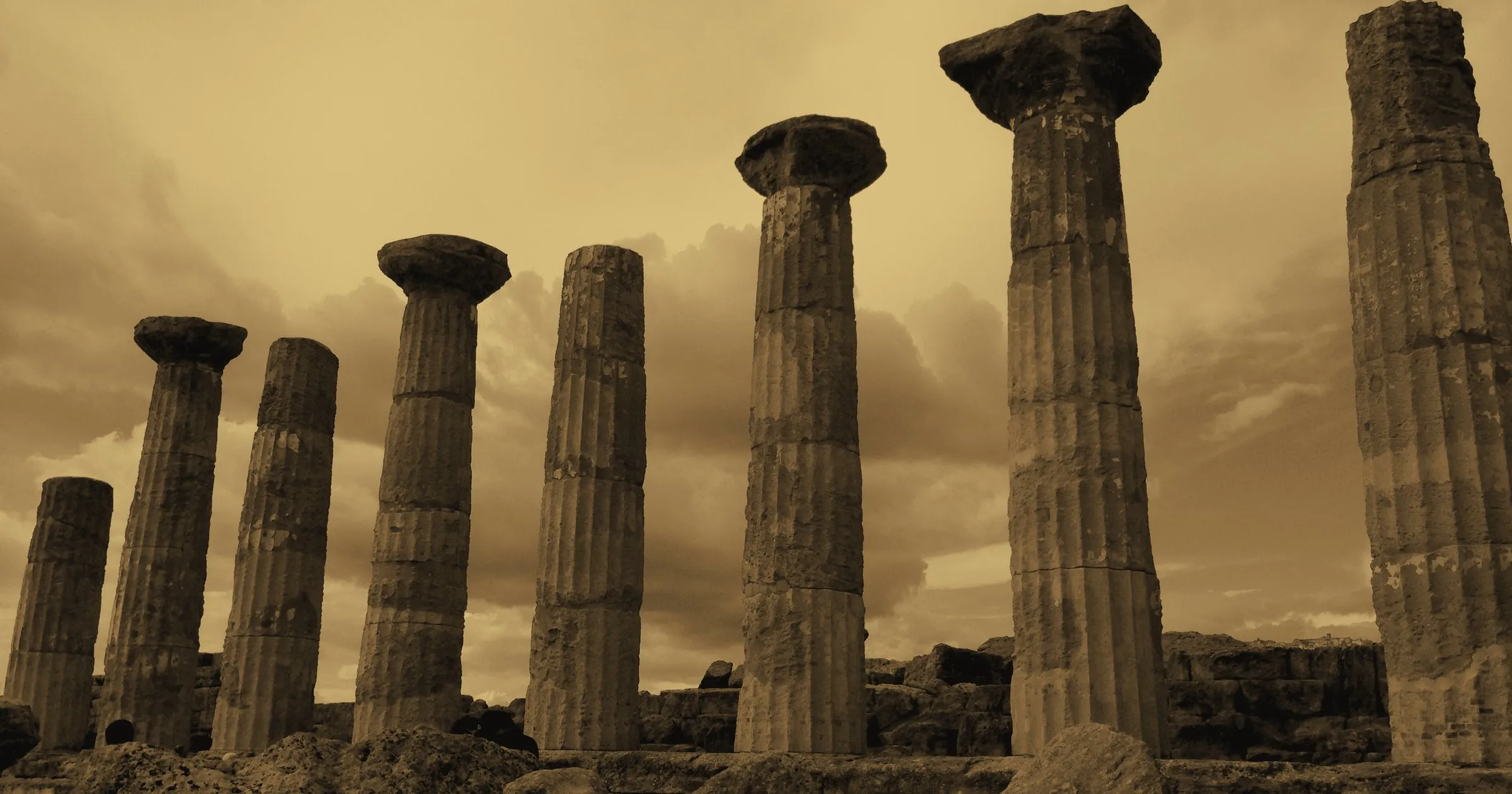
The story of Western civilisation begins, we are told, in Greece. Philosophy, logic, geometry, medicine, history, drama and democracy, all of it arriving more or less from nowhere in a few hundred years around the Aegean, in what gets called the Greek miracle.
There is an awkward problem with the miracle, and it is not that modern scholars have debunked it.
It is that the Greeks did not believe it either.
They were, in fact, embarrassingly clear about where their knowledge had come from, and they wrote it down, repeatedly, in texts we still have and still assign to undergraduates. The forgetting happened later, and it was not done by them.
Start with Thales of Miletus, traditionally the first philosopher, the man who said everything is water and thereby, in the standard account, launched rational inquiry as such.
The ancient sources are unanimous that Thales studied in Egypt, and that he learned his geometry there.
Pythagoras is reported to have spent years in Egypt, and the theorem attached to his name appears on Babylonian tablets more than a thousand years before he was born, as a worked procedure rather than an abstract proof.
Herodotus goes furthest. He states that the Greeks took their religious practices from Egypt, that geometry was an Egyptian invention, and that Greek civilisation owed specific and profound debts to Egyptian and Mesopotamian precedent.
So the testimony is not ambiguous, not fragmentary, and not the product of some revisionist rereading. The Greeks kept the register. They named their sources.
The forgetting is a later project, and you can more or less date it. Renaissance humanists needed a classical inheritance that was purely European. Enlightenment philosophers needed reason to have a birthplace rather than a supply chain.
What makes this case so useful is that nothing had to be destroyed to bring it off.
No library was burned. No inconvenient manuscript was suppressed. Herodotus was not banned; he was set as a text.
This is the most efficient form of erasure there is. You do not suppress the evidence. You demote it. It stays in the corpus, technically available, and drops out of the summary, and the summary is what a civilisation actually believes.
A Greece that inherited, adapted and improved is a far more interesting Greece than a Greece that sprang from nothing. What the Greeks did with what they received, turning Egyptian surveying procedures into deductive geometry, turning Babylonian observation into cosmological theory, inventing the idea that a claim should come with a proof, is a genuine and enormous contribution. It is just not a virgin birth.
They knew that. They said so. They named the teachers.
Then two thousand years later, people who had never set foot in Egypt decided the Greeks had been too modest, and quietly corrected them.