
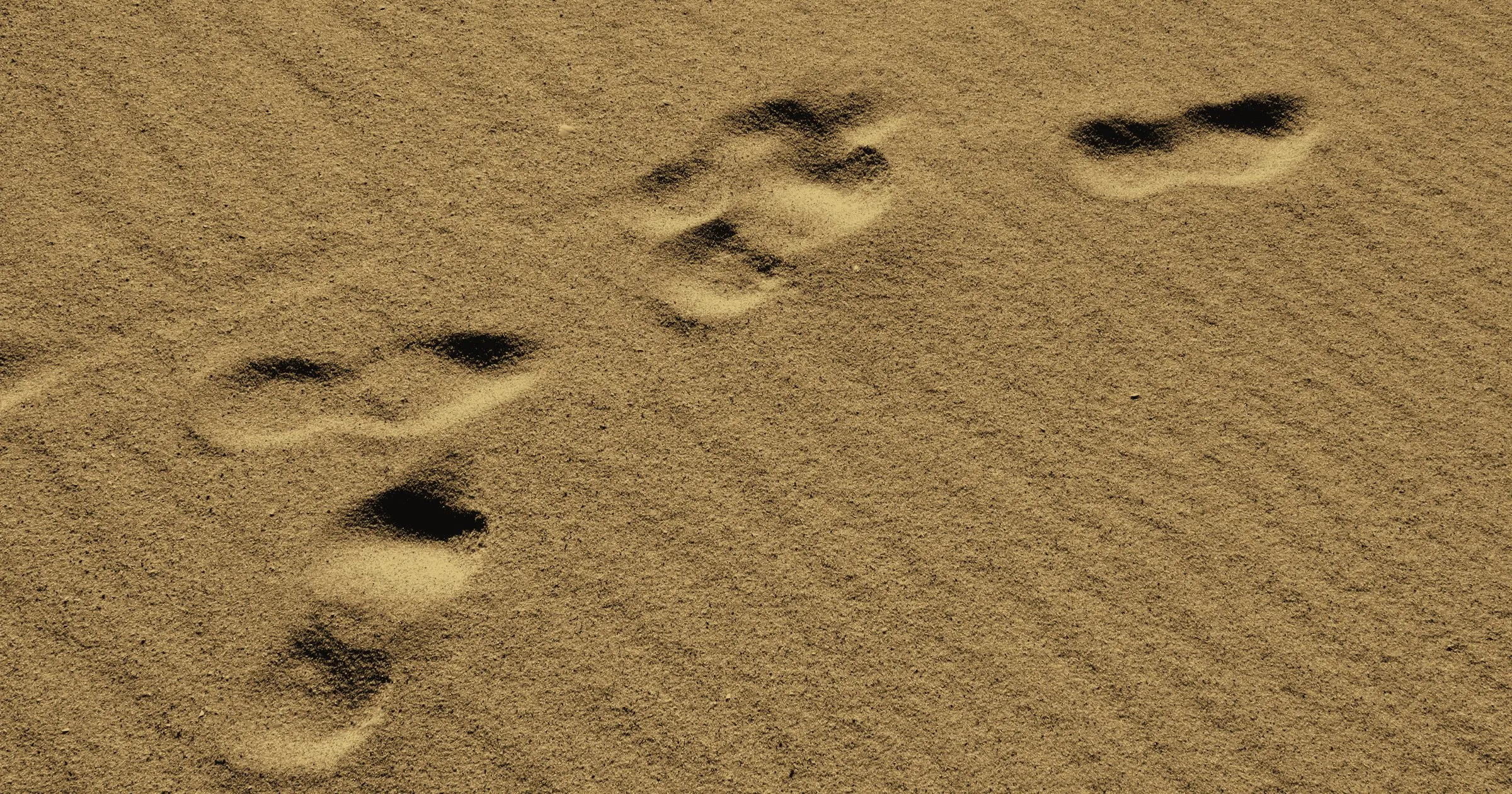
At White Sands in New Mexico there are footprints in what used to be the soft margin of a lake. They have been dated to around twenty-three thousand years ago.
Some of them were made by children.
Hold that for a second, because it is the whole argument in one detail. Not scouts. Not a hunting party pushing into unknown country. Families, with children old enough to run about on a muddy shore while the adults did whatever they were doing. Nobody brings children to a frontier.
The problem is that according to the model taught for most of the last century, they could not have.
The standard account had the Americas populated around thirteen thousand years ago by people walking south from Alaska through an ice-free corridor between the Laurentide and Cordilleran ice sheets.
Twenty-three thousand years ago that corridor did not exist. The two ice sheets were fused. There was no overland route.
What interests me is not that the model was wrong. Models are wrong all the time; that is what they are for. What interests me is how long it stayed standing.
Part of this is healthy. A discipline that revised its chronology every time somebody found an odd stone would not be a discipline. Scepticism is the job.
But part of it is simply that disagreeing was a career risk.
Consider the position of a young archaeologist in 1985 with an inconveniently early date. The safe move is to assume you made an error, requery the lab, bury the result in a footnote, and work on something else. Do that enough times across enough careers and a paradigm can outlive its evidence by thirty years without anyone anywhere telling a lie.
The Americas are the control group for the entire history of knowledge.
Whatever moved between civilisations in the Old World, the Mesopotamian inheritance in Egypt, the Silk Road, the Islamic translation movement, the Latin West's debt to Arabic scholarship, none of it reached the Americas before 1492. No Babylon, no Greek philosophy, no Chinese paper, no Indian numerals.
And in that isolation they built cities larger than contemporary London, worked out a positional number system with a zero, tracked Venus with an accuracy that embarrassed European astronomy for centuries, and ran agricultural systems supporting populations that Europe could not feed.
Independently. From nothing but the same equipment every human being is issued at birth.
The footprints were always there. We had simply agreed, collectively and without ever deciding to, on a story that did not have room for them.