
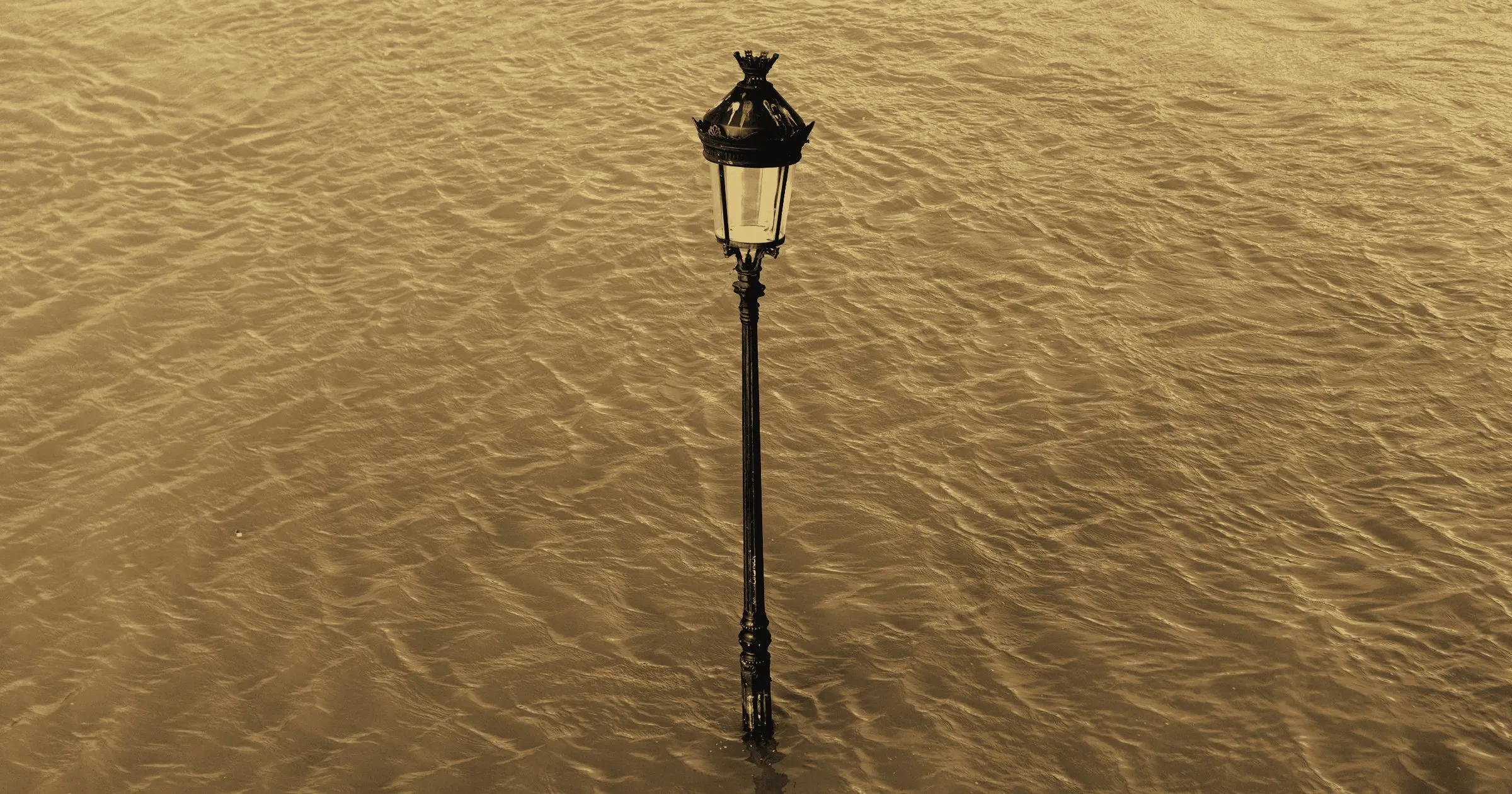
Nearly every branch of the human family remembers a flood.
Mesopotamia has Utnapishtim, Genesis has Noah, the Qur'an has Nuh. But so does India, in the story of Manu and the fish. So does Greece, with Deucalion. So do the Maya in the Popol Vuh, the Aboriginal Australians, the Norse, the Chinese, dozens of peoples across the Americas, the Pacific islanders. Different names, different gods, different moral weight. Same water.
This is usually handled in one of two ways, and both are unsatisfying.
The first says it proves a single global deluge exactly as described, which the geology does not support. The second says it proves nothing, because rivers flood everywhere and people tell stories. That one is technically defensible and quietly lazy. Rivers flood everywhere, yes. They do not usually produce a narrative about the end and restart of the world, retained across thousands of years by peoples with no contact.
Set the myths aside and read the ice cores instead.
At the glacial maximum, ice sheets up to three kilometres thick sat over northern Europe, northern Asia and North America. The Laurentide sheet over Canada and the northern United States held enough frozen water on its own to lower global sea level by around seventy metres. Add Fennoscandia and Antarctica and the sea stood roughly 120 metres below where it stands now.
Then it melted. Not steadily. In pulses.
Meltwater Pulse 1A, about 14,650 years ago, raised global sea levels by an estimated fifteen to twenty metres in under five centuries. In geological terms that is instantaneous. In human terms it is slow enough to be survivable and fast enough to be unmistakable: a coastline that moves visibly within a lifetime, a village site your grandmother described that is now offshore, a retreat repeated by generation after generation.
So the flood myths are not evidence of Atlantis. They are evidence of something better attested and more interesting: a species that went through a real, protracted, planet-wide catastrophe and carried the memory of it in the only technology it had.
In a world without writing, narrative is the storage medium. Encode the event in a story with gods and moral stakes and a memorable shape, and it will survive being retold ten thousand times across four hundred generations. Encode it as a list of dates and sea levels and it will be gone in three.
The myth is not a failed attempt at history. It is a successful attempt at persistence.
The survivors did the one thing they could. They put it in a story, handed the story to their children, and told them to hand it on.
Twelve thousand years later, we still have the story.
Which means it worked.