
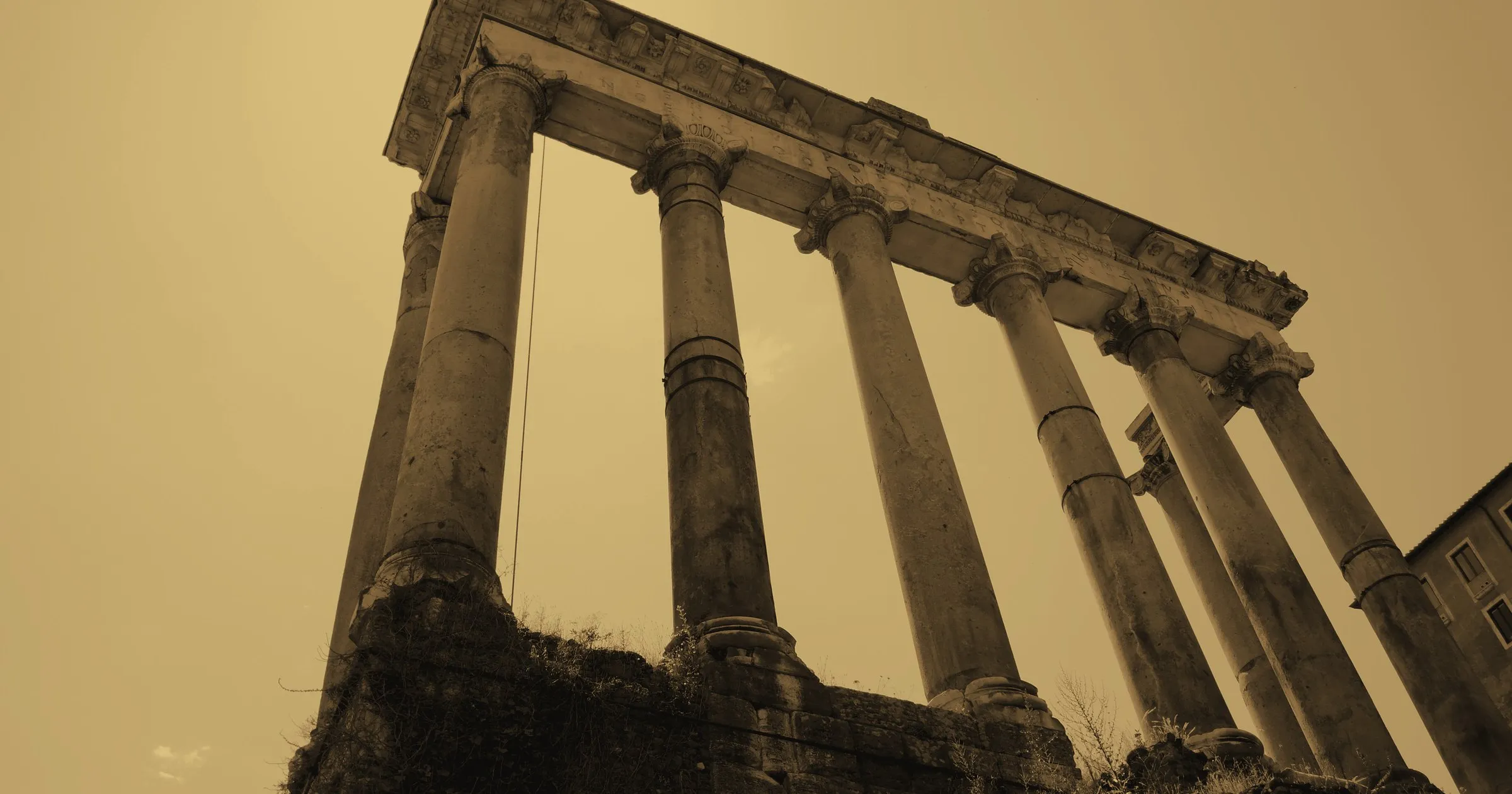
There is a line that runs from the Roman Forum to the European Parliament. Not a line of descent, but a line of logic: there are civilised people and there are barbarians, and the difference is moral, not just geographical.
Rome did not invent hierarchy. It did something more lasting. It universalised it. It declared that its way of ordering society was not one option among many but the only legitimate form of human life, and it built an empire to enforce that claim.
To have civitas was to live within law, order and reason. Outside it lay the barbaricum, where Romans saw human life barely above that of animals. The barbarian did not merely live elsewhere. The barbarian was less.
Inside the frontier, the ranking was exact. Full citizens at the top, with the right to vote, hold office and appeal to Roman law. Below them, partial citizens. Below them, subjects who paid Roman taxes and had no voice. Below them, slaves. And beyond the border, barbarians whose conquest needed no justification beyond their barbarism.
When Rome fell, the logic survived. The Church took up its universal claim and renamed the categories. Civitas and barbaricum became Christendom and heathendom. Citizenship as the reward for assimilation became salvation as the reward for conversion. Every European project since, from the Spanish empire to the British to the French civilising mission, has made the same claim: there is one correct way to live, we have it, and those who do not are deficient.
The barbaricum has moved. It is no longer beyond the Rhine. It is in the banlieues of Paris, the tower blocks of East London, the mosques of Rotterdam.
I live inside it. I carry a British passport and pay British taxes, and the civilisation I contribute to has classified the community I belong to as a problem to be managed.
But there is a difference between Rome and now, and it is not the one Europe likes to claim.
Rome was honest. It did not pretend to be equal. It said plainly that some people were citizens, some subjects, some slaves, and built its institutions accordingly.
Modern Europe says the opposite. Its constitutions declare everyone equal. Its charters forbid discrimination by religion or origin. And it produces the outcomes Rome would have produced deliberately: disproportionate surveillance, restrictions on religious practice, five percent of the population treated as an existential threat. It produces them while denying that it is producing them.
That is not simple hypocrisy. It is worse. Europe has renounced hierarchy in its language and kept it in its logic, and the gap between the two is where the machine works undisturbed.
The Romans were candid about the ranking. We are asked to be grateful for ours.