
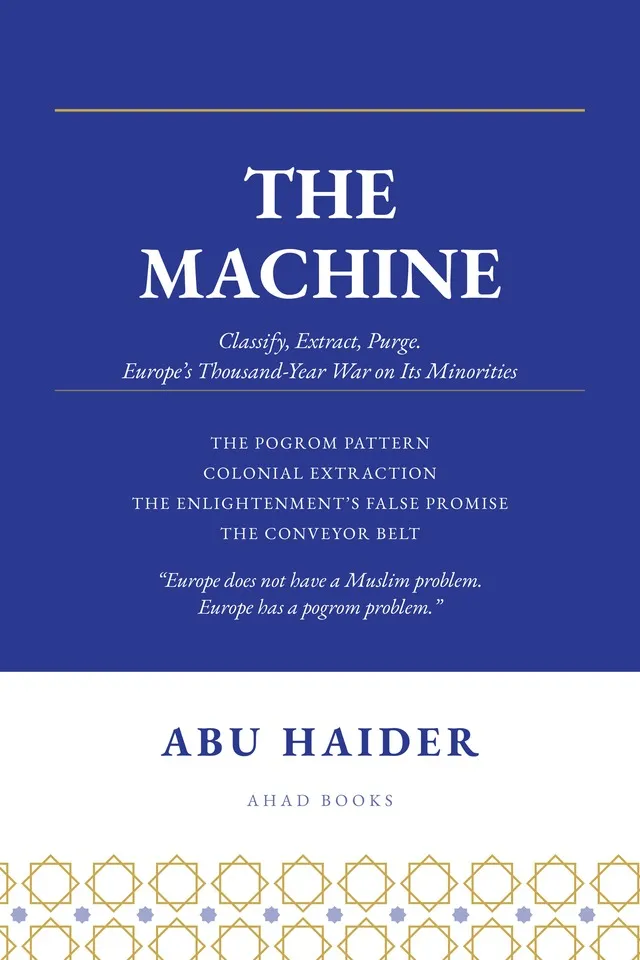
The Machine
Classify, Extract, Purge. Europe's Thousand-Year War on Its Minorities
For a thousand years, Europe has run the same machine. Identify a minority as different. Extract their labour, their taxes, their talent. Then, when the political moment demands unity through exclusion, purge them. The Cathars. The Jews. The Irish. The Roma. The Huguenots. The Slavs. The targets rotate. The mechanism endures.
41 essays, one for each chapter, all free to read.
Start reading
Coming soon
- IntroductionTie Your CamelEvery Muslim household in Europe carries a question it rarely asks out loud: what if the country you were born in decides you do not belong? History has answered it before, many times.
- Chapter 1: The Core ThesisThe Machine Does Not Need You to Be GuiltyClassify, extract, purge: Europe has run the same sequence on its minorities for a thousand years. It has never selected its targets for what they did, only for being available.
- Chapter 2: The Theoretical FrameworkA Civilisation That Cannot Say What It IsFive percent of Western Europe is described as an existential threat to five hundred million. Ibn Khaldun explained the gap six centuries ago: a civilisation in decline needs an enemy.
- Chapter 3: Roman Imperial UniversalismThe Romans Were at Least HonestRome ranked its people openly: citizens, subjects, slaves, barbarians. Modern Europe declares everyone equal and produces the same outcomes, while denying it is producing them.
- Chapter 4: Greek Taxonomy and the Ranking ImpulseThe Student Cannot Disagree With the TeacherAristotle wrote that some people are slaves by nature. Europe kept the habit of ranking every difference it meets, which is why a Muslim objection is heard as backwardness, not argument.
- Chapter 5: Christian SupersessionismYou Are Being Asked to Accept You Are Out of DateChristianity claimed to replace the faith before it, and the Enlightenment claimed to replace faith itself. Integration, as Europe defines it, asks Muslims to agree that they are the earlier draft.
- Chapter 6: Feudalism and Blood PurityConversion Was Never EnoughFifteenth-century Spain baptised its Jews and Muslims, then decided baptism did not count. Purity of blood replaced purity of faith, and the logic still decides who is really from here.
- Chapter 7: The Westphalian SettlementThe Nation-State Was Built to Have No MinoritiesThe peace that ended Europe's religious wars made one faith per realm the price of stability. From Breton schoolrooms to Bismarck's Kulturkampf, the modern state has been removing difference ever since.
- Chapter 8: The Enlightenment's False PromiseThe Ladder Is the ProblemMuslims are told their civilisation needs its own Enlightenment. The advice assumes a ladder with Europe at the top, built by men who ranked humanity by race and called it reason.
- Chapter 9: The Albigensian CrusadeEvery Inquisition Outlives Its HereticsThe crusade against the Cathars killed French Christians for their theology and their land. Its most lasting product was not a massacre but an institution, and institutions look for their next target.
- Chapter 10: The Expulsion of the JewsAssimilation Did Not Save ThemLearn the language, adopt the customs, serve the country, and you will be accepted. The Jews of Europe kept that bargain for centuries, from Spain's converts to Germany's veterans. It did not save them.
- Chapter 11: The IrishNot Christian EnoughThe Irish were white, Christian and European, and the machine ground them down for centuries anyway. Their survival is told as proof that integration works. Look at what it cost.
- Chapter 12: The RomaNever Again Has a FootnoteThe Roma were in the camps too. No reparations, no museums, then sterilisation into the 1990s. Their story shows the machine can idle for centuries, and that Europe's great promise was never universal.
- Chapter 13: Slavs and Eastern EuropeansA Majority Can Vote for the MachineEurope was taught to see its east as backward, then offered it full membership for helping police the Muslim. Hungary took the deal as a democracy, which shows what elections can and cannot stop.
- Chapter 14: The HuguenotsThe Huguenots Who Survived Were the Ones Who LeftEurope tells the Huguenot story as proof that refugees can be absorbed. They were absorbed because they were nearly the same already, and the ones who survived as Huguenots were the ones who left.
- Chapter 15: The Doctrine of DiscoveryClassified Before We Were BornIn 1452 a papal bull authorised the enslavement of Saracens and pagans wherever they were found. It has been secularised since, but never withdrawn, and Muslims in Europe arrived already classified.
- Chapter 16: Blood Purity Becomes Race ScienceThe Speaker Hears Common SenseLinnaeus sorted humanity by colour, temper and how each was governed. After 1945 race became culture and blood became values. The ranking survived; only its vocabulary was made respectable.
- Chapter 17: Colonial EconomicsThe Owners Were CompensatedWhen Britain abolished slavery it paid the owners, and Haiti was made to pay France for its own freedom. Europe took the wealth, imported the labour, and now asks why the descendants are poor.
- Chapter 18: Divide and RuleDivide and Rule Came HomeColonial borders were drawn to keep the governed divided. The same technique now sorts Europe's Muslims into moderate and radical, good and bad, Turkish and Pakistani, so they never speak with one voice.
- Chapter 19: The MirrorEurope Is Looking at a MirrorEurope tells itself colonialism happened elsewhere. It happened at home too, and the intensity of the reaction to Muslims is not really about Islam. It is about the reflection.
- Chapter 20: The Labour PipelineNobody Built a Place for the PeoplePost-war Europe invited hands, not people, and prepared nothing but the job. Decades later it looked at the neighbourhoods its wages had built and called them parallel societies.
- Chapter 21: The Colonial BoomerangThe Tools Always Come HomeThe methods built to govern Muslims in colonial Algeria and to fight insurgencies from Malaya to Belfast have returned to Europe, renamed. They now operate in the school at the end of the street.
- Chapter 22: The Banlieue as ColonyThe Explanation Is Always CulturalThe banlieue is blamed on the culture of the people inside it. The cause was concrete, cheap land and a colonial map redrawn inside France, and a cultural diagnosis guarantees it never gets fixed.
- Chapter 23: The Évolué System Comes HomeEvery Success Story Is Used Against the RestThe Belgian Congo let a native apply to be certified as evolved. Europe's integration tests work the same way, and the Muslim who passes becomes the proof that everyone else has only themselves to blame.
- Chapter 24: Granada and the Morisco ErasureThe Treaty of Granada Lasted Ten YearsIn 1492 a signed treaty guaranteed Granada's Muslims their faith, property and law. Within a decade it was convert or leave. Nine centuries of presence and a written promise protected no one.
- Chapter 25: Srebrenica and the Bosnian GenocideThey Knew Their KillersThe Muslims of Bosnia shared streets, schools and marriages with the people who killed them. Srebrenica shows that when the machine activates, friendship is overridden and the neighbour becomes a category.
- Chapter 26: FranceThe Machine Does Not Need the Far RightFrance's most sweeping anti-Muslim law was passed by the centre, in the language of liberty. The machine does not need the far right to win, only the centre to adopt its logic.
- Chapter 27: The United KingdomAssumed for Some, Demanded of OthersNobody objects to democracy or the rule of law. The problem with British values is who is asked to prove them: the majority passes by default, and a Muslim's failed performance is read as risk.
- Chapter 28: Germany and AustriaIntegration Renamed Infiltration"Political Islam" has no stable definition, which is its use. It catches the organisers, advocates and candidates who took the invitation to belong at its word, and files their integration as infiltration.
- Chapter 29: Scandinavia and the NetherlandsThe Test Is Designed to Be FailedScandinavia and the Netherlands did not abandon liberal values to exclude Muslims. They used them: handshake ceremonies, values exams and Quran burnings, each a loyalty test built to be failed.
- Chapter 30: The Normalisation of the Far RightThe Firewall Was Opened From the InsideIn 2000 Europe sanctioned Austria for letting the far right into government. In 2022 Italy elected Mussolini's heirs and nothing happened. The mainstream did not resist the far right. It adopted it.
- Chapter 31: The Architecture of What Comes NextThe Census Comes FirstBauman showed that the infrastructure of persecution is always built before the persecution. An audit of Europe's laws, revocation powers and surveillance asks not what anyone intends, but what is now possible.
- Chapter 32: The SynthesisThe Machine Is Getting FasterEurope has erased a Muslim population within its borders twice. Al-Andalus took more than a century. Bosnia took three years. The most important thing about the pattern is that it is accelerating.
- Chapter 33: 1920 or 1935?The Distance Is Measured in ElectionsMeasured against the stages Weimar Germany passed through, Europe's Muslims stand somewhere between 1920 and 1933. What separates the stages is not decades but crises, elections and the will to act.
- Chapter 34: The Honest Conversation We Are Not HavingHope Is Not a StrategyHope in the mercy of Allah is a virtue. Hope that one country's politics will stay favourable forever is a calculation resting on a wish, and a community has been running on it for twenty years.
- Chapter 35: Build Here, But Build StrategicallyBuild for Survival, Not ApprovalFor sixty years the community built showcases for acceptance, and acceptance never came. The answer is to keep building, but for survival: economic, educational, legal and political strength that also creates options.
- Chapter 36: Plan BA Fire Escape Is Not a PredictionEvery ship carries lifeboats and nobody calls it pessimism. Twenty-five million Muslims in Europe have no contingency plan, and the hijrah itself was prepared, not improvised.
- Chapter 37: The Third OptionBuild Here, Prepare ElsewhereStay or leave is a false choice. Build here as if staying forever, prepare as if leaving tomorrow. Local excellence is what makes a community mobile, and mobility is what makes it free.
- Chapter 38: What We Owe Our ChildrenWhy Do They Not Like Us?Every Muslim parent in Europe hears the question from a child eventually. What we owe them is not comfort and not fear, but the truth in pieces, and two truths held together.
- Chapter 39: A Theology of Strategic FaithBlessed Are the StrangersEuropean Muslims are told they would be welcome if they were less strange. The Prophet, peace be upon him, called the strangers blessed. Strangeness held with engagement is not failure but fidelity.
- Epilogue: A Letter to My ChildrenLove This Place and Be Ready to Leave ItA father writes to his sleeping children: this country is yours, and it has a history of revoking belonging. Love it honestly and prepare anyway, because they deserve honesty more than comfort.