
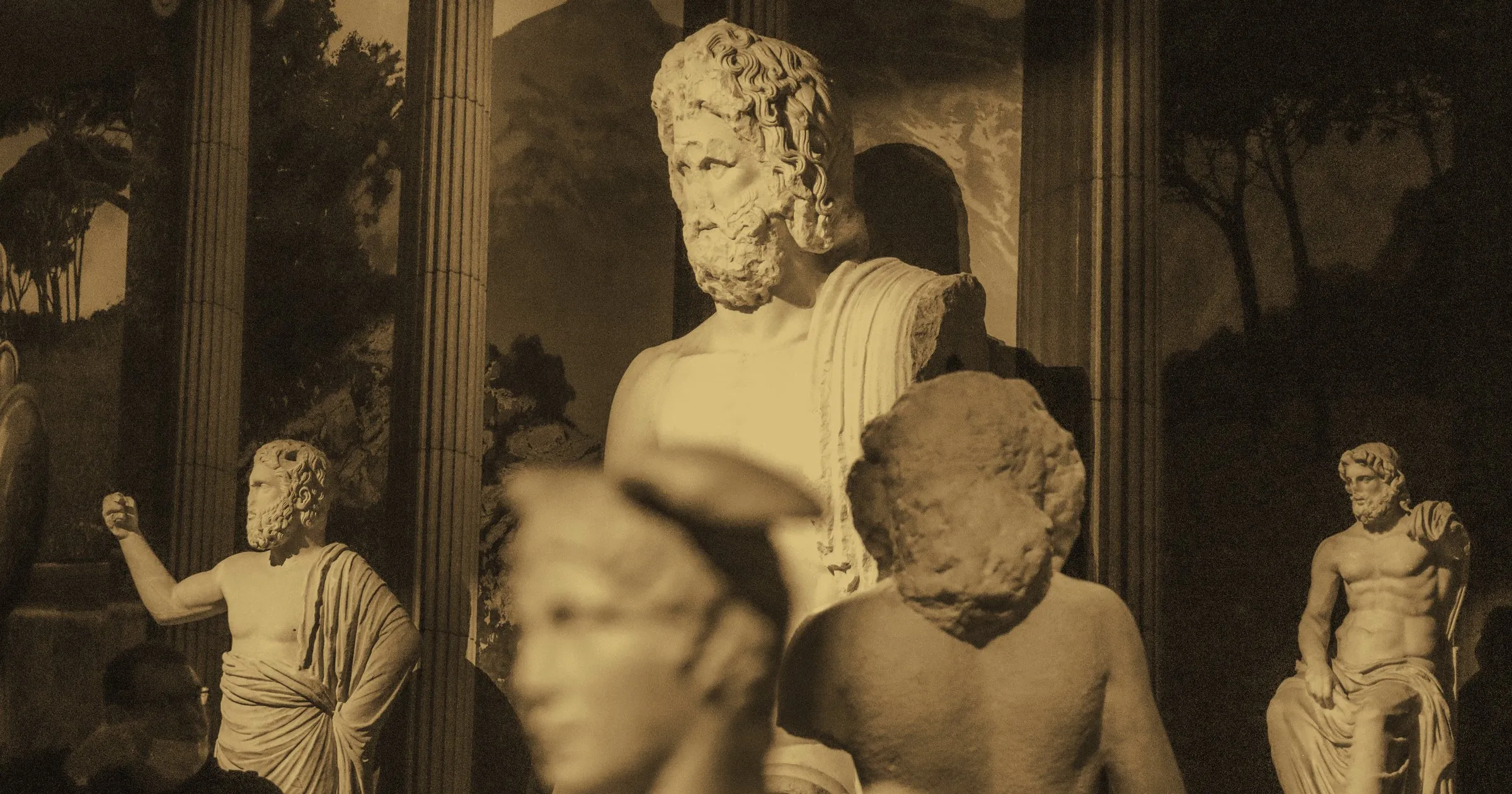
The Greek word barbaros is a sound effect. It mimics speech that makes no sense: bar-bar-bar. The barbarian was the one who could not talk properly.
Notice what that means. The barbarian was not defined by any particular failing. He was defined by not being Greek. The category was empty in the middle. Whatever made a person fully human was, by definition, Greekness, and everyone else lacked it.
That structure is the prototype for every European classification of the Other that followed.
Aristotle made it respectable. One of the most powerful minds in human history wrote, with the calm of a man stating a fact, that some human beings are slaves by nature.
It was not a stray remark. In his universe, everything had a fixed nature and a proper place. The acorn becomes an oak. The knife cuts. The slave serves. The free man rules. And the line between the naturally free and the naturally servile ran, conveniently, along the line between Greeks and barbarians.
Hierarchy stopped being a political choice. It became a feature of the cosmos.
Europe never returned that gift. It only translated it. The medieval Great Chain of Being ranked all creation from God to dust, with Europeans above everyone else. In 1735 Linnaeus sorted humanity into four types, each with a temperament: Europaeus governed by law, Afer by caprice. When Europeans met the peoples of other continents, the question was never "who are these people?" It was "where do they rank?"
The content kept changing. Greekness, then Christianity, then reason, then liberal values. The impulse did not. Difference could not be met without being placed above or below.
For Muslims in Europe, this has a consequence that is easy to feel and hard to name.
Islam is not treated as a different way of living. It is treated as an earlier one, a stage Europe has already passed through. Attachment to religious law, to community, to different norms about family and modesty, is read not as a position but as developmental delay.
Which means Muslim disagreement cannot be heard as disagreement. When you object to a demand, you are not an equal making an argument. You are the student resisting the teacher. The unenlightened refusing progress. Your objection becomes further evidence of the very backwardness it was meant to dispute.
Before a single word of dialogue is spoken, the ranking is already done, and you have already been placed below.
That is why so many conversations about "integration" feel rigged. They are. Not by the people in the room, but by a habit of mind two and a half thousand years old, one that cannot encounter difference without ranking it.